
Mass production programming and further upgrade: Complete the adaptation of Infineon's PSoC Edge E8 edge AI chip solution
Recently, our company has officially completed the mass production programming and security injection full-process solution adaptation for Infineon's new-generation edge AI flagship platform, PSoC™ Edge E8 (industry abbreviation EDGE8).
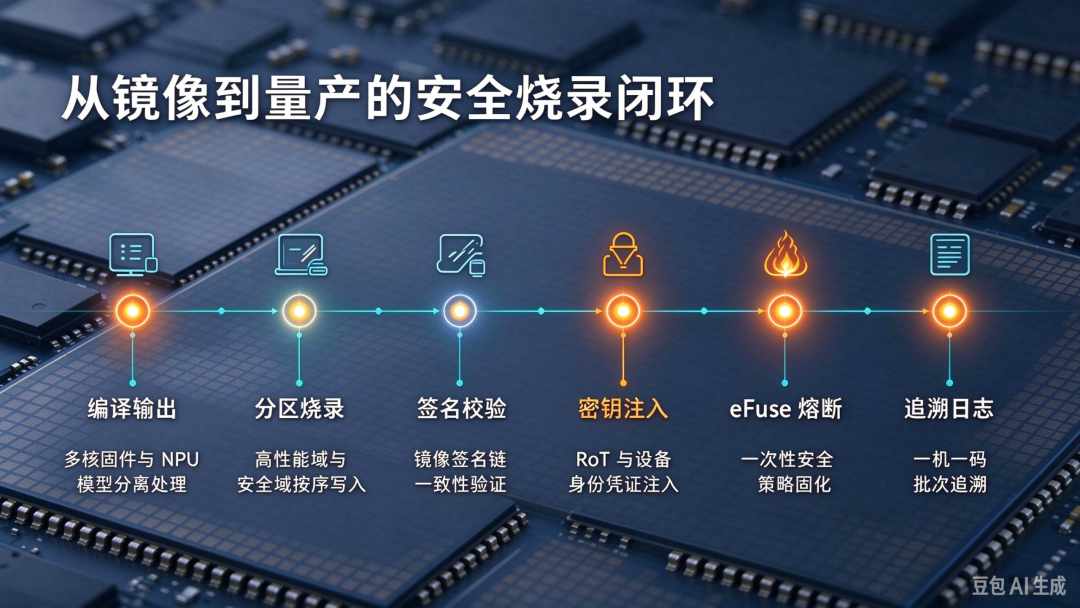
This solution covers the stages from sample debugging, trial production to mass SMT production. It enables unified programming and verification of multi-core firmware, AI model images, secure boot strategies, root of trust keys, and device identity credentials for the EDGE8 platform, helping customers shorten the mass production introduction cycle from EVT, DVT to MP stages.
1. Why is EDGE8 receiving attention from edge AI?
PSoC Edge E8 is a heterogeneous multicore MCU platform launched by Infineon for local AI inference. Its core value lies in integrating high-performance computing, always-on capability with low power consumption, and high security protection into a single chip.
Its main features include:
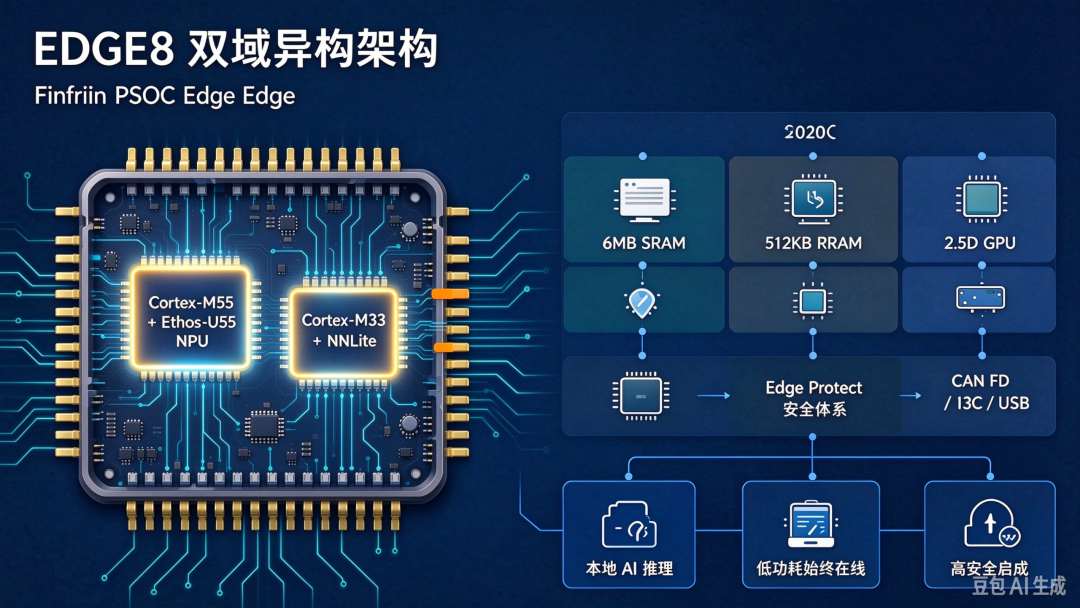
Dual-domain heterogeneous architecture: Cortex-M55 paired with Ethos-U55 NPU and Helium DSP, responsible for high-performance local AI inference; Cortex-M33 paired with NNLite, responsible for low-power always-on tasks.
Large-capacity on-chip storage: up to 6MB SRAM, integrated with 512KB ultra-low-power RRAM.
Graphics and multimedia capabilities: Equipped with a built-in 2.5D GPU, suitable for HMI, graphical interaction, and local display applications.
Rich peripheral interfaces: Supports CAN FD, I3C, high-speed USB, multi-microphone audio interface, etc.
High security system: Integrated with Edge Protect security capabilities, it supports secure boot, root of trust, tamper resistance, side channel attack protection, eFuse policy hardening, and unique device identity credentials.
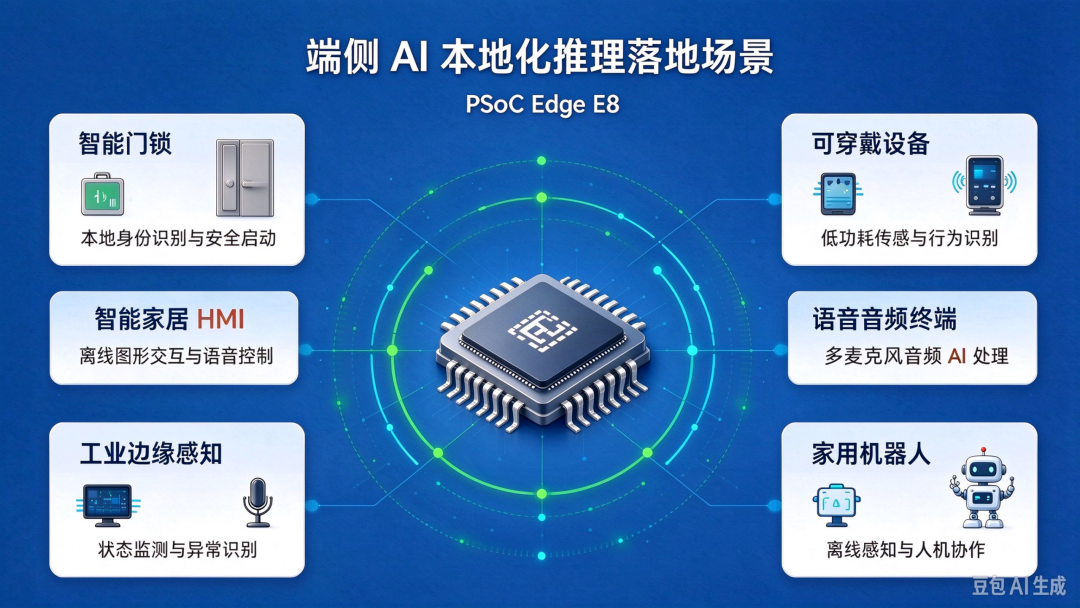
For vendors who are transitioning from traditional MCUs to local AI, EDGE8 is suitable for applications such as smart door locks, wearable devices, smart home HMI, voice and audio terminals, industrial edge perception, and household robots.
II. What are the difficulties in mass production programming of EDGE8?
Unlike traditional single-core MCUs, the mass production programming of EDGE8 is not a simple single-image download process, but rather a systematic engineering involving multi-core booting, AI model partitioning, security configuration, and key injection.
During the mass production introduction process, customers often encounter the following issues:
1. Complexity of multi-core mirroring and AI model partitioning
The EDGE8 platform comprises a high-performance domain, a low-power domain, and a security domain. Firmware images and NPU models need to be written according to partition, offset, and boot sequence. Any disorder in the image sequence or partition relationship may lead to boot failure or abnormal AI inference loading.
2. Strict security startup and signature chain verification
The security capabilities of EDGE8 are built upon secure boot, image signing, and a root-of-trust system. During the mass production programming process, the integrity and trustworthiness of firmware, models, and configuration data must be ensured.
If the signature chain, certificate, or boot policy do not match, the chip may enter an unexpected security state, potentially affecting subsequent mass production.
3. eFuse programming is irreversible
Once an eFuse is blown, it is usually impossible to restore it. Therefore, in mass production programming, it is not only necessary to ensure that the programming is successfully completed, but also to guarantee the following:
Verify before programming;
Stable power supply during programming;
Readback verification after programming;
The key and policy are accurate and correct.
4. High requirements for one machine one code and batch traceability
For smart home, industrial, and high-security applications, customers often require unique device identities, serial number binding, key version management, and production log traceability. This necessitates a programming solution that not only supports single-chip operation but also possesses production-line-level data management capabilities.
III. What capabilities are supported by the EDGE8 mass production programming solution?
Our company's EDGE8 programming solution, which we have successfully completed this time, revolves around five key aspects: "multi-core image programming, AI model partitioning, secure injection, eFuse management and control, and production line traceability".
1. Support multi-core firmware and NPU model partition programming
The solution can handle multi-core firmware images compiled and output by ModusToolbox, and write high-performance domain, low-power domain, security domain, and NPU model data into the chip by partition.
This means that customers no longer need to manually handle the programming sequence for different images, but can instead complete unified programming and verification through a standardized process.
2. Support secure boot image signature verification
During the burning process, the integrity of the image, signature status, and boot conditions are verified to ensure that only validated firmware and models can proceed to the subsequent operational state.
This step is a crucial link in preventing illegal firmware, abnormal images, and unauthorized models from entering mass production equipment.
3. Support RoT, key, and device identity injection
The solution supports the injection of root keys, device unique certificates, DICE identity credentials, and secure boot policies, meeting the mass production configuration requirements of the high-security version EDGE8 platform.
For customers, this capability is directly related to trusted device booting, firmware protection, model intellectual property protection, and subsequent security upgrades.
4. Support eFuse controlled programming
The eFuse programming process follows a "verify first, program second, read back" workflow to minimize the risk of irreversible configuration errors.
For customers entering the MP phase, this process is particularly crucial. This is because if the eFuse strategy is incorrect, the entire batch of devices may face rework or even scrap.
5. Support one machine, one code and batch traceability
The scheme can be traced by combining serial numbers, batch numbers, key versions, programming times, and result logs, meeting the production management requirements of some industrial, smart home, and high-security customers.
4. Which application scenarios are supported?
The positioning of PSoC Edge E8 determines that it is highly suitable for end products that require local AI inference, low-power operation, and high security protection.
1. Smart door lock
The smart door lock can utilize the local AI capabilities of EDGE8 for identity recognition, while protecting the core algorithms and control logic of the door lock through secure boot, root of trust, and eFuse strategies.
2. Wearable devices
Wearable devices are typically sensitive to power consumption. The low-power Cortex-M33 domain and NNLite of EDGE8 are suitable for processing sensor data, behavior recognition, and always-on tasks.
3. Smart home HMI
Intelligent central control systems, smart panels, and home appliance HMI with graphical interfaces can leverage the 2.5D GPU and local AI capabilities of EDGE8 to achieve offline voice recognition, display interaction, and local control.
4. Voice and audio terminal
EDGE8 supports multi-microphone audio interfaces and local AI inference, making it suitable for building offline speech recognition, sound source localization, echo cancellation, and audio analysis terminals.
5. Industrial edge perception
Industrial sensors, condition monitoring devices, and edge controllers can leverage EDGE8 to perform data preprocessing, anomaly detection, and real-time control locally, reducing reliance on the cloud.
6. Household robots
The local perception, obstacle avoidance, voice interaction, and motion control of household robots can also benefit from the enhanced real-time AI processing capabilities provided by the heterogeneous architecture of EDGE8.
V. Value to customers: transitioning AI from demonstration to production
EDGE8 boasts notable technical advantages, but it also elevates the threshold for mass production. While many customers can successfully run AI models in the lab, they often encounter challenges related to programming, security configuration, and version management when transitioning to the trial and mass production stages.
Our company has successfully adapted the EDGE8 mass production programming solution, and its core value lies in:
Reduce the time cost for customers to develop their own programming tooling and scripts;
Reduce the adaptation risks between multi-core images, AI models, and security policies;
Provide a unified programming path from sample debugging to SMT mass production;
Support the mass production closed-loop for keys, certificates, eFuse, and log traceability.
For customers who are advancing the implementation of end-to-end AI products, a mature programming solution is not just "adding flowers to a brocade", but a necessary step from Demo to mass production.
VI. Follow-up Planning
Currently, our company has completed the mass production programming and security injection solution adaptation for the Infineon PSoC Edge E8 edge AI platform. Moving forward, we will continue to enhance our capabilities in the following directions:
Extend the programming support for different packages and module forms of EDGE8;
Strengthen the encryption partitioning and version management of AI models;
Integrate more automatic burn-in machines with SMT production lines;
Improve security key management, device identity management, and mass production traceability system.
As the demand for edge-side offline AI continues to grow, platforms like EDGE8, which combine heterogeneous computing, low power consumption, and high security capabilities, will receive increasing industry attention. Stable, secure, and traceable mass production programming capabilities will become an important foundation for customers to smoothly advance product implementation.
The completion of the EDGE8 mass production programming solution marks our further expansion in the field of high-security edge AI chip mass production. Moving forward, we will continue to focus on overseas high-end MCUs, edge AI chips, and wireless platforms, providing more comprehensive firmware programming, secure injection, and mass production supporting services.
If you are developing smart door locks, wearables, HMI, voice and audio, industrial edge, or household robot products based on PSoC Edge E8 and require support for mass production programming, key injection, or security configuration, please contact us to discuss specific solutions.