
MaxWiz has completed the adaptation of the programming capability for the Nordic nRF54H20 chip, facilitating the mass production and deployment of IoT wireless terminals.
Recently, our company has officially completed the chip programming capability adaptation for Nordic's new-generation wireless SoC nRF54H20, providing process-oriented support for sample debugging, small-batch trial production, and mass production programming around customer firmware images.
As the fourth-generation multi-protocol heterogeneous multi-core platform from Nordic, the nRF54H20 is highly competitive in terms of low-power wireless connectivity, multi-protocol concurrency, secure boot, and edge computing, making it suitable for applications such as LE Audio, Matter smart home, industrial wireless nodes, medical wearable devices, and edge AI terminals.
Compared to traditional single-core Bluetooth chips, the difficulty of nRF54H20 lies not only in the wireless protocol itself, but also in the multi-core architecture, multi-image partitioning, security configuration, and collaboration with mass production processes. This is also where customers often encounter complex programming timing, difficulties in image matching, and high requirements for security key management when transitioning from research and development to mass production.
In light of this characteristic, the focus of this capability adaptation is centered around the following aspects:
1. Support multi-core and multi-image programming
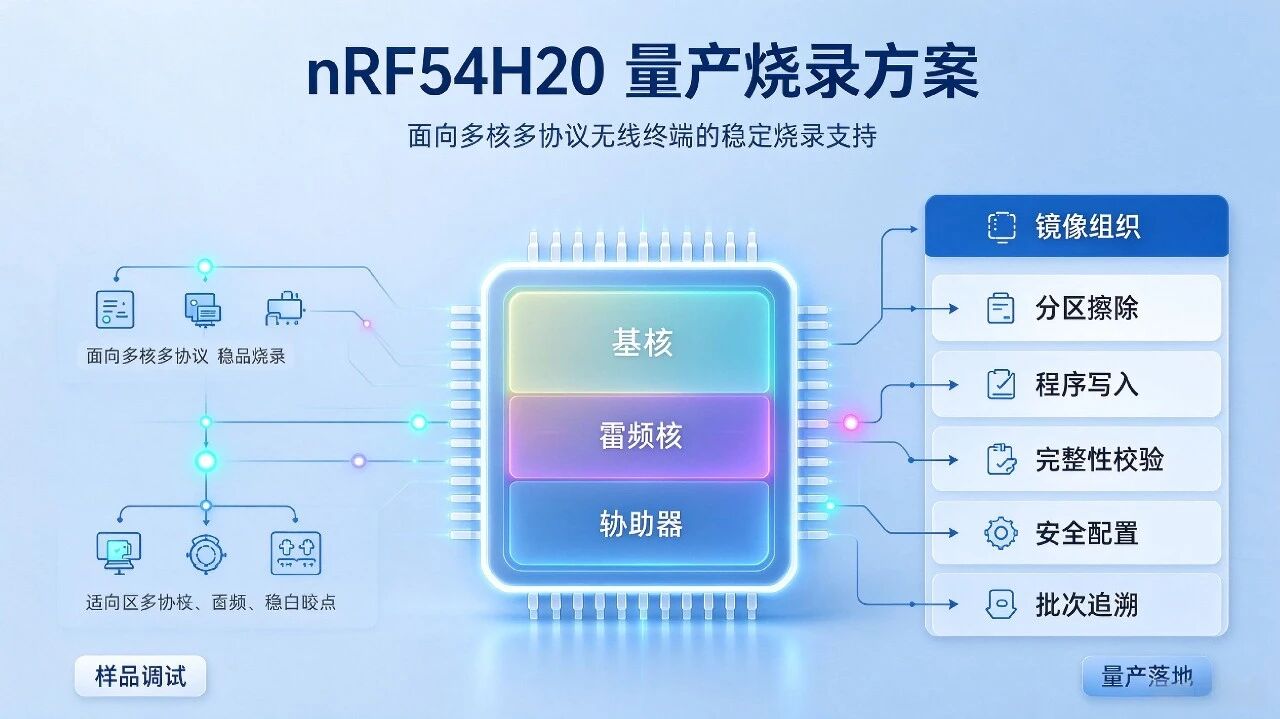
nRF54H20 adopts a heterogeneous multicore architecture, where the application core, RF core, and coprocessor require different firmware images for programming. Our company has completed the process verification of multicore image organization, partition erasure, program writing, and integrity verification, helping customers reduce startup issues caused by image mismatch, sequence anomalies, or partition configuration errors.
II. Covering development, debugging, and mass production programming scenarios
Chip programming is not a single step, but a complete process that spans from product development to mass production. The current solution covers:
Rapid debugging and programming during the R&D stage;
Small batch trial production verification;
Stable programming during the mass production phase;
Record and trace the firmware version and programming results.
This cohesive capability helps customers use the same set of clearer programming specifications at different stages, reducing redundant development between R&D and production lines.
III. Considerations for supporting secure boot and key management
nRF54H20 emphasizes security capabilities, so the mass production programming process also needs to incorporate security configurations. The solution can support secure boot configuration, key programming, firmware encryption, and access permission management according to customer project requirements, reducing the risk of firmware reverse engineering and illegal copying.
This is particularly important for customers in industries such as industry, healthcare, and smart home, who have high requirements for stability and safety.
IV. Adapt to various chip forms and production line requirements
Chips will appear in different forms at different stages. This adaptation supports common forms such as bare chips, chips, and modules, and can interface with different types of programming devices and production line tooling. Whether it's laboratory verification or mass production before and after SMT, the process can be matched according to the customer's production line.
V. Mass production supporting capabilities for the Nordic ecosystem
Our team has been paying close attention to the mass production programming requirements of Nordic series chips for a long time, and has accumulated corresponding engineering experience around platforms such as nRF52, nRF53, nRF54, and nRF91.
The implementation of the programming capability for nRF54H20 signifies that customers can establish a stable mass production programming process earlier when using this platform for product development, reducing project delays caused by immature programming processes in the later stages.
Industry value: From "being able to burn" to "being able to produce"
Many IoT projects progress smoothly during the R&D stage, but when it comes to mass production, they encounter issues in the programming phase: complex images, unclear security configurations, unstable production lines, and incomplete traceability records.
Multi-core and multi-protocol chips like nRF54H20 boast strong performance, but they also impose higher requirements on mass production support. True stable programming capability involves not just writing firmware into the chip, but also addressing issues such as image management, security configuration, production line adaptation, and version traceability.
Therefore, the significance of this capability adaptation lies not only in supporting a specific chip, but also in assisting customers in establishing a more reliable mass production foundation when adopting the new generation of Nordic platform.
Applicable fields
Currently, nRF54H20 is widely considered suitable for the following applications:
LE Audio audio device;
Matter smart home terminal;
Industrial wireless sensor nodes;
Wearable and medical monitoring devices;
Edge AI and sensor fusion terminal;
High-security wireless module product.
If customers are developing solutions based on nRF54H20 and wish to establish a mass production programming process in advance, they can conduct a specific solution evaluation focusing on firmware images, chip form factors, production line environments, and security requirements.
Conclusion
Nordic nRF54H20 represents the evolution of low-power wireless SoC towards multi-core, multi-protocol, high security, and edge intelligence. For domestic IoT solution providers, the ability to quickly establish mass production links has become one of the key factors for product implementation.
The completion of this programming capability adaptation marks another extension of our capabilities in the field of wireless chip mass production services. Moving forward, we will continue to focus on the Nordic ecosystem and other mainstream chip platforms, assisting customers in shortening the cycle from research and development to mass production.